
These free mental wellness tools are built for people who overthink, worry or struggle to switch off at night. Each one takes a few minutes and gives you either a clear result or a private dashboard you can come back to. Nothing you type is sent to us.
All of these free mental wellness tools take a few minutes. Trackers save your entries only in your own browser, so nothing you write is sent to us. They are for self-reflection and education, not diagnosis or treatment.
Sleep
How Much Sleep Do I Need?New
Estimate your personal sleep need, weeknight shortfall and bedtime, then check it with a 7-night log.
Open the tool →Sleep Debt Calculator
See how much sleep you missed this week, with a gentle catch-up plan.
Open the tool →Night Thoughts Sleep Log
A one-minute morning log that shows which wind-down habits help you fall asleep.
Open the tool →Overthinking and worry
Am I Overthinking? Quiz
Ten short questions show whether your overthinking is light, moderate or heavy.
Open the tool →Rumination Check & Worry Time
Run the 3-question check on a loop and track how many minutes loops take.
Open the tool →Racing Thoughts Reset
A guided 5-4-3-2-1 grounding exercise with a dashboard of what helps.
Open the tool →Five-Line Journal
A short, structured journal that shows whether writing calms you or feeds the loop.
Open the tool →Self-talk and relationships
Boundaries With Parents WorksheetNew
Plan one limit, get a script for Mom or Dad and track how they respond.
Open the tool →Boundaries Quiz
Map your six types of boundaries, get words to say and track how it goes.
Open the tool →Inner Critic Reframe Tracker
Catch a harsh thought, name its pattern and rewrite it.
Open the tool →Reassurance Urge Pause
A 20-minute pause timer for the urge to ask “are we okay?”
Open the tool →Thought & Urge Tracker
For when you can’t stop thinking about someone.
Open the tool →Calm and mindfulness
3-Minute Breathing Space
A guided timer to step back from looping thoughts.
Open the tool →Notice & Name Practice Log
Track how quickly you notice thoughts and step back.
Open the tool →Getting support
In crisis? Call or text 988 in the US, or find a free helpline in your country at findahelpline.com.
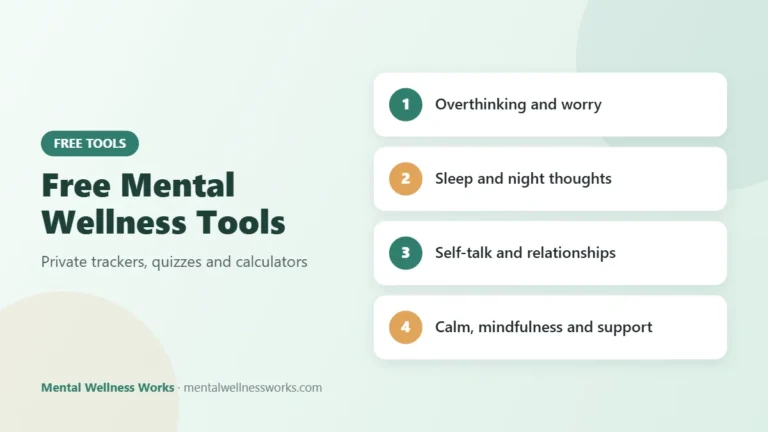
How our free mental wellness tools work
Most of the tools are trackers. You log a short entry, such as a worry loop, an urge or a night of sleep, and the tool builds a dashboard from your entries: averages, streaks, before-and-after charts, the triggers or themes that come up most, and a short insight based on your own pattern. The quizzes and calculators give an instant result instead.
Each tool is linked to an in-depth guide on the same topic, so you can understand the ideas behind it as well as practice them.
Who these free mental wellness tools are for
They are for adults who overthink, worry a lot, replay conversations, struggle with a harsh inner voice or find it hard to switch off at night, and who want practical, private ways to practice new habits. They also work well alongside therapy: many people use a tracker between sessions and share the downloaded summary with their therapist. If you are in crisis or feel unsafe, these tools are not the right place to start; please contact a crisis line or emergency services first.
Why we built these tools
Reading about overthinking helps, but change usually comes from practicing a skill and seeing that it works for you. Most self-help advice stops at “try this”. These tools add the missing step: a simple record of what you tried and what happened, so you can keep what helps and drop what does not.
Each of our free mental wellness tools is based on techniques with research behind them or widely used in therapy, such as worry postponement, slow breathing, sleep diaries, cognitive reframing and mindful noting. Where the evidence is limited, the tool page says so.
Tips to get the most from a tracker
- Pick one tool to start with, not five.
- Log for at least one to two weeks before judging the results.
- Keep entries short. Thirty seconds to a minute is enough.
- Look at your dashboard once a week, ideally at a calm moment.
- Use the download button to keep a copy or share it with a therapist.
What each area of the free mental wellness tools covers
Overthinking and worry tools help with loops, rumination and racing thoughts. Sleep tools help you understand how much sleep you need and what helps you switch off at night. Self-talk and relationships tools focus on the inner critic, reassurance seeking and thoughts about someone you cannot stop thinking about. Calm and mindfulness tools give you short guided practices. Getting support helps you plan for therapy.
How to choose from the free mental wellness tools
- Your mind keeps looping on the same problem: start with the rumination check and worry time tracker.
- Your thoughts are fast and scattered: try the 5 4 3 2 1 grounding technique.
- Your inner voice is harsh: use the inner critic reframe tool.
- You keep asking “are we okay?”: practice the reassurance pause.
- Someone is always on your mind: log it in the no contact tracker.
- You cannot switch off at night: keep the sleep diary and check how much sleep you need.
- You are not sure where you stand: take the overthinking quiz first.
Your privacy
Tracker entries are stored only in your own browser, using your device’s local storage. We do not have accounts, and we never receive what you write. That also means your entries do not move between devices, and clearing your browser data deletes them, so use the download button in each tool if you want to keep a copy.
Are these tools a diagnosis?
No. They are for self-reflection and education, based on published research and widely used self-help techniques. They cannot diagnose a condition or replace care from a doctor or licensed therapist. If your results or your feelings worry you, please talk to a professional.
New tools are added regularly, usually alongside a new in-depth guide. If there is a tool you would find useful, such as a tracker for a habit you are trying to change, let us know through the contact page. We read every suggestion and use them to decide what to build next.
Frequently asked questions about free mental wellness tools
Are the tools really free?
Yes. All tools are free to use and do not need an account.
Can I use the tools on my phone?
Yes. Every tool works on phones, tablets and computers. Entries are saved in the browser you use.
Do you store my answers?
No. Calculations and dashboards run in your browser, and entries stay on your device.
Which tool should I start with?
If you are unsure, take the 2-minute overthinking quiz, then try the tool linked to your result.