
This free boundaries quiz maps all six types of personal boundaries in about three minutes. Rate 12 short statements about the last month, and your Boundary Map shows which boundaries are healthy, which are porous (too loose) and which are rigid (too strict), and which one to work on first. Then build a sentence you can actually say, and track how it goes.
Boundaries Quiz: Which Boundary Needs Attention First?
Answer 12 quick statements to map your six types of boundaries, see which ones are too loose or too strict, get a sentence you can actually say, and track how it goes. Everything stays in this browser.
Start here
Your six boundaries
A boundary is something you do, not something you demand. Pick the situation and get a short sentence to start from, then make it sound like you.
Practiced
boundaries logged
Held
fully or partly
Guilt
Streak
days in a row
Guilt after each boundary
Boundaries you practiced most
For self-reflection, not diagnosis. If someone ignores your boundaries in ways that make you feel unsafe, your safety comes first: in the US call the National Domestic Violence Hotline at 1-800-799-7233, or find local help at findahelpline.com.
How the boundaries quiz works
There are two statements for each of the six types of boundaries: physical, emotional, mental, material, sexual and time. One statement checks whether a boundary is too loose, such as saying yes to favors when you are already stretched. The other checks whether it is too strict, such as turning down requests you would actually enjoy. You answer from “rarely” to “almost always”.
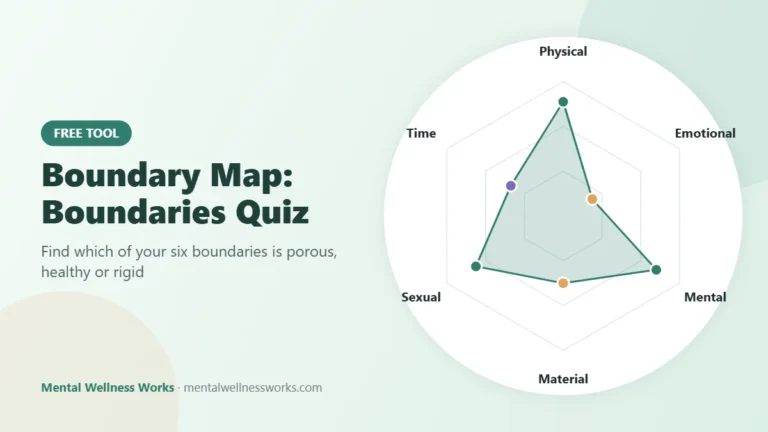
In the boundaries quiz, each type is then labelled porous, healthy or rigid, the same three styles used in Therapist Aid’s boundary worksheet. The hexagon on your map shows how healthy each type is: the closer a point sits to the edge, the healthier that boundary. The type with the lowest score becomes your “start here” boundary.
The six types of boundaries on your map
- Physical: your body, personal space and privacy.
- Emotional: your feelings, and how much you take on from others.
- Mental: your thoughts, beliefs and opinions.
- Material: your belongings and money.
- Sexual: your consent, comfort and safety.
- Time: your hours, energy and availability.
For examples of each type in daily life and why different sources count different numbers, read our full guide to the types of boundaries.
Porous, healthy or rigid: what your result means
- Porous (too loose): you give in to avoid conflict, take on other people’s feelings or say yes and then resent it.
- Healthy: your limits are clear and specific, and you can still flex when it makes sense.
- Rigid (too strict): you keep people out, even when you would like to be closer or would be glad to help.
Most people who take the boundaries quiz have a mix. You might be firm at work and porous with family. The goal is not more boundaries or stricter ones, but clear boundaries that fit the situation. If a boundary shows as rigid, the sentence builder gives you a line that opens the door a little instead of closing it.
An example map
Ravi takes the boundaries quiz and answers “often” to taking on his friends’ problems and “almost always” to saying yes at work when he is already stretched. His map shows emotional and time boundaries as porous, mental and physical as healthy, and material as rigid, because he never lends anything, even to his brother. The tool picks emotional boundaries as his starting point.
In the “Say it” step he chooses “Friend” and a kind tone, and edits the suggested line to: “I care about what you are going through, but I am wiped out tonight. Can we talk tomorrow at lunch?” Over the next two weeks he logs six boundaries. He holds five of them, and his guilt after each one drops from about 7 to 4 out of 10. When he retakes the boundaries quiz, the dashed line on his map shows the emotional point has moved outward.
Build a sentence you can actually say
Social worker Karen Salerno advises being specific and using “I” statements rather than hints (Cleveland Clinic). Psychologist Dr. Karin Ryan points out that a boundary is about your own behavior, not about controlling someone else. The sentence builder follows both ideas: pick the boundary, the person and a kind or firm tone, and you get a short line to start from. Edit it until it sounds like you.
If someone pushes back, you do not need a new reason each time. A calm repeat such as “I’ve already shared my answer, and it hasn’t changed” is enough, as long as you follow through.
Track your practice and the guilt that comes with it
Guilt often shows up after the first few boundaries. It does not prove you did something wrong; it can simply mean you are breaking an old pattern. Each time you use a boundary, log which type it was, who it was with, how it went and how much guilt you feel. Your dashboard shows how many boundaries you held, your streak, a chart of guilt after each one and which types you practice most. For many people, the most encouraging thing is watching the guilt bars get shorter.
Who this boundaries quiz is for
It is for adults who feel drained, resentful or taken for granted, who find it hard to say no, or who suspect they keep people at too much distance. The boundaries quiz also works as a starting point before reading a boundaries book or working on boundaries with a therapist. It is not a diagnosis, and it is not designed for situations involving abuse or control.
When boundaries are not enough
If setting a boundary feels impossible or frightening, if saying no leaves you in distress for days, or if someone ignores your boundaries in ways that make you feel unsafe, please reach out for support. In the US, the National Domestic Violence Hotline is available at 1-800-799-7233 or thehotline.org. Elsewhere, find local help at findahelpline.com. A licensed therapist can also help you build boundaries in a way that feels safe.
Frequently asked questions
What are the six types of boundaries?
A common framework lists physical, emotional, mental, material, sexual and time boundaries. Each protects something different: your body, feelings, beliefs, belongings, consent and hours.
What is the difference between porous and rigid boundaries?
Porous boundaries are too loose: you let almost anything through, often to avoid conflict. Rigid boundaries are too strict: you keep people out, even when closeness or help would be welcome.
How often should I retake the boundaries quiz?
Every two to four weeks is enough. Your previous map appears as a dashed outline, so you can see which boundaries have grown.
Are my answers private?
Yes. Your answers, map and practice log are saved only in your browser on your device.
Sources
- Salerno K. How to set healthy boundaries. Cleveland Clinic Health Essentials; 2026.
- Ryan K. Boundaries: what they are and how to set them. Sagent Behavioral Health (formerly Nystrom & Associates).
- Therapist Aid. Boundary types worksheet.
- National Domestic Violence Hotline. thehotline.org.