
This free overthinking journal keeps each entry to five short lines and ends with a next step, so writing gives a worry a place to land instead of a bigger stage. Rate how loud the worry is before and after you write, and your private dashboard shows your streak, your before-and-after trend and the themes that keep coming back.
Five-Line Journal for Overthinkers
Write one short, structured entry, rate your worry before and after, and watch your dashboard show whether journaling is calming you or feeding the loop. Entries stay in this browser on your device. We never see them.
“That is enough for tonight.”
Entries
Streak
days in a row
Avg. change
worry points after writing
Next steps
entries ending in an action
Worry before and after writing
Themes that keep coming back
Words that repeat in your worry lines. Review them once a week, not in the middle of a spiral.
Recent entries
For general education, not therapy. If writing brings up painful memories or panic, stop and talk with a licensed professional. In crisis? Call or text 988 (US) or find a helpline at findahelpline.com.
Why a structured journal works better for overthinkers
Writing about thoughts and feelings has been studied for decades. A 2023 meta-analysis by Lin Guo found that expressive writing produced a small reduction in symptoms of depression, anxiety and stress, with the benefit often showing up later rather than straight away. Small means real but limited.
The risk for overthinkers is that open-ended writing can turn into rumination on paper: the same worry, rewritten in new words, for three pages. One trial found that expressive writing helped people who normally express emotions easily but left people who rarely express emotions more anxious at follow-up (Niles et al., 2014). Structure helps. Separating facts from guesses and ending with a step gives each entry an edge and an end point.
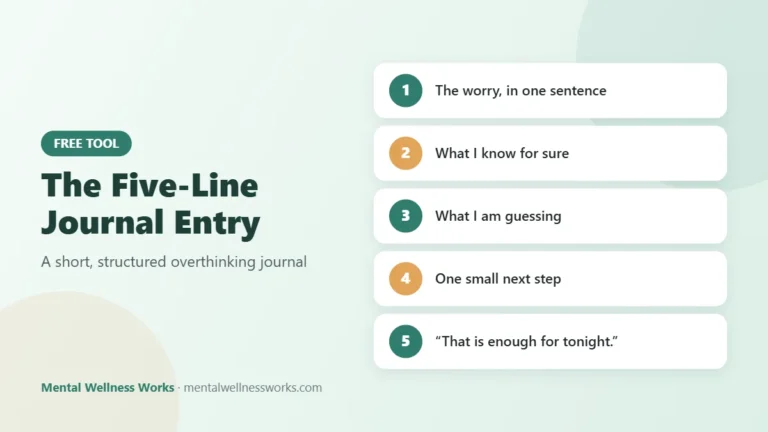
How to write a five-line entry
- The worry. One sentence only, such as “My manager seemed annoyed in the meeting.”
- What I know for sure. Only things a camera could record: “She said we would discuss the report on Friday.”
- What I am guessing. The story your mind added: “She thinks my work is bad.”
- One small next step. “Ask on Friday what she wants changed.” If there is nothing to do yet, say so.
- Closing line. “That is enough for tonight.” Then close the journal.
Use the optional 10-minute timer if your entries tend to run long. The goal is not a perfect entry; it is a short, honest one that you will actually repeat.
An example entry
It is 9 pm and Daniel cannot stop replaying a comment he made at dinner. He rates the worry at 8 out of 10 and writes:
- Worry: I think I offended my sister at dinner.
- Know: She changed the subject after my joke about her job.
- Guessing: She is upset and thinks I don’t respect her work.
- Next step: Text her tomorrow to ask how her week is going.
- Closing line: That is enough for tonight.
He rates the worry again at 5. After a week of entries, his dashboard shows an average drop of about two points, a streak of five days, and that “work” and “sister” appear in several entries. That gives him something specific to think about in daylight, instead of at 9 pm.
Who this journal is for
It suits people who replay conversations, second-guess decisions or lie awake running through what-ifs, and who have tried free writing only to feel more wound up. It also works well as practice between therapy sessions.
What your overthinking journal dashboard shows
- Entries and streak, so you can see whether the habit is sticking.
- Average change in how loud the worry feels after writing.
- Next-step rate, the share of entries that end in an action.
- Before-and-after chart for your last 14 entries.
- Repeating themes, words that show up in two or more worry lines.
If the worry gets louder after writing in most of your recent entries, the dashboard tells you. That is a useful signal, not a failure. Try shorter entries, take a few days off, or switch to a more activity-based approach, and talk to a professional if writing brings up painful memories or panic.
Journal prompts for overthinking
If you prefer prompts to a blank page, these work well alongside the five lines:
- What would I tell a friend who had this exact thought?
- What is the most likely outcome, not the worst one?
- If this still matters in a week, what will I do about it then?
- What is one thing I did today that went fine?
- Which part of this is mine to solve, and which part is not?
For a deeper look at different journal styles and products, read our guide to a journal for overthinkers that actually works.
Your entries stay private
Entries are saved only in this browser on your device. We never receive them. Clearing your browser data removes them, so use the download button if you want to keep a copy.
Frequently asked questions
How long should I journal each day?
About ten minutes is a practical starting point. Short, regular entries are more useful than long ones, especially for overthinkers.
When is the best time to journal?
Many people find early evening works well, so thoughts are parked before bedtime. If thoughts are loudest at night, keep entries short and stop at the closing line.
Should I reread old entries?
Yes, once a week, to spot repeating themes. Avoid rereading in the middle of a spiral, which can feed the loop.
Can journaling replace therapy?
No. It can be a helpful habit and good practice between sessions, but it is not a treatment for anxiety or depression.
Sources
- Guo L. The delayed, durable effect of expressive writing on depression, anxiety and stress: a meta-analytic review of studies with long-term follow-ups. British Journal of Clinical Psychology. 2023;62(1):272–297.
- Niles AN, et al. Effects of expressive writing on psychological and physical health: the moderating role of emotional expressivity. Anxiety, Stress, & Coping. 2014;27(1):1–17.