
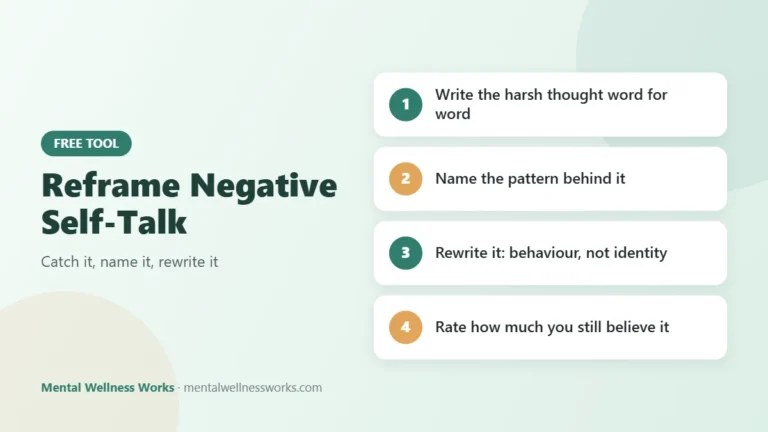
This free tool helps you reframe negative self talk one thought at a time. Write the harsh line exactly as your inner critic says it, name the pattern behind it, rewrite it the way a fair friend would, and rate how much you believe it before and after. Your dashboard shows which patterns your critic uses most and whether the rewrites are working.
Why the inner critic makes your mind feel loud
Overthinking is often less about the number of thoughts and more about their tone. A harsh inner voice turns a small mistake into a verdict about who you are, and verdicts are hard to stop replaying. Kristin Neff’s work on self-compassion describes the alternative: treating yourself with the same kindness and fairness you would offer someone you care about (Neff, 2003).
How you talk to yourself also matters. In a series of studies, people who silently used their own name or “you” instead of “I” while thinking about a stressful task felt less anxious and performed better (Kross et al., 2014). The rewrite step uses that idea to help you reframe negative self talk.
Common negative self-talk examples and their patterns
- Name-calling: “I’m such an idiot.”
- Always / never: “I always ruin things.” “I never get it right.”
- Mind reading: “They think I’m boring.”
- Fortune telling: “This is going to go badly.”
- Should / must: “I should be over this by now.”
- Catastrophizing: “If I make one mistake, I’ll lose my job.”
Naming the pattern is the first step to reframe negative self talk, and it is useful on its own. Research on affect labeling suggests that putting a feeling into words can reduce its intensity (Lieberman et al., 2007).
An example: how Priya learned to reframe negative self talk
After a meeting, Priya’s inner critic says: “You sounded stupid. Everyone noticed. You always freeze.” She writes it word for word and picks Always / never as the pattern. She believes it at 8 out of 10.
Her rewrite: “Priya, you lost your train of thought for a few seconds in one meeting. Most people were focused on their own updates. You have spoken clearly in plenty of meetings before.” When she rates the original thought again, it is at 4.
Over two weeks her dashboard shows that Always / never and Mind reading are her critic’s favorite patterns, and that rewriting cuts her belief in the harsh thoughts by about three points on average. Knowing the pattern helps her catch it and reframe negative self talk faster next time, often before it turns into an evening of replaying the meeting.
Who this tool is for
It is for anyone who wants to reframe negative self talk that is harsher than they would ever be with a friend: people who replay mistakes, call themselves names or assume the worst about what others think. It is also a useful way to practice skills from CBT or compassion-focused therapy between sessions.
How to reframe negative self talk with this tool
- Write the thought word for word, even if it sounds harsh.
- Pick the closest pattern from the list.
- Rate how much you believe it right now.
- Rewrite it. Describe the behavior, not your identity, and use your own name: “Sam, you said one awkward sentence. It happens, and it does not define you.”
- Rate the original thought again.
Aim for believable, not positive. “I am great” rarely lands. “That went badly, and I can fix it” often does.
What your dashboard shows
- Reframes saved and your streak.
- Average drop in how much you believe the harsh thought after rewriting.
- Your loudest pattern and a chart of all patterns.
- Before-and-after chart and repeating words from your thoughts.
Our guide Quiet Your Mind: Your Self-Talk Might Be the Noise explains three small changes to the voice that make the biggest difference.
When to get more support
If your inner critic is constant, very cruel, or comes with low mood that lasts more than two weeks, talk to a doctor or licensed therapist. Approaches such as CBT and compassion-focused therapy work directly on harsh self-talk and can help you reframe negative self talk with a professional’s guidance.
Frequently asked questions
What is the inner critic?
It is a common name for the harsh, judging voice in your thoughts. Everyone has one to some degree; the goal is to make it fairer, not silent.
Does positive self-talk work?
Overly positive statements often feel false. Balanced, specific and kind statements tend to be more believable and more helpful.
Why use my own name?
Studies suggest that talking to yourself in the second or third person creates a little distance, which can make it easier to respond fairly.
Is my writing saved anywhere?
Only in your browser on your device. Nothing is sent to us.
Sources
- Kross E, et al. Self-talk as a regulatory mechanism: how you do it matters. Journal of Personality and Social Psychology. 2014;106(2):304–324.
- Lieberman MD, et al. Putting feelings into words: affect labeling disrupts amygdala activity in response to affective stimuli. Psychological Science. 2007;18(5):421–428.
- Neff KD. Self-compassion: an alternative conceptualization of a healthy attitude toward oneself. Self and Identity. 2003;2(2):85–101.