
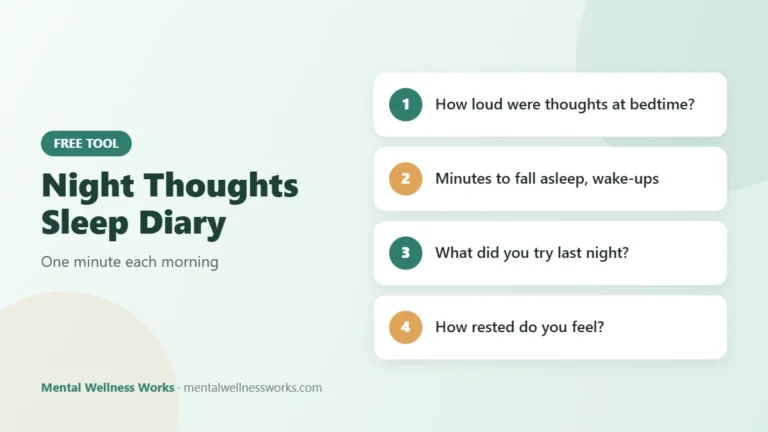
A night thoughts sleep diary is one of the simplest ways to understand your sleep. This free online sleep diary is built for people whose thoughts get loud at night. Each morning, log how loud your thoughts were at bedtime, how long it took to fall asleep, how often you woke and what you tried. After a week or two, your dashboard compares nights with and without wind-down habits, so you can see what actually helps you.
Why keep a night thoughts sleep diary?
Sleep specialists use sleep diaries because memory is unreliable, and a night thoughts sleep diary adds the one thing most logs leave out: how busy your mind was before sleep. After a few bad nights, it can feel like you never sleep, while a diary often shows a more mixed picture. Researchers developed a standard consensus sleep diary so that daily sleep records could be collected in a consistent way (Carney et al., 2012).
Sleep diaries are also part of cognitive behavioral therapy for insomnia (CBT-I), which the American Academy of Sleep Medicine recommends as a treatment for chronic insomnia in adults (Edinger et al., 2021). This tool is not CBT-I, but it collects the kind of information a clinician would ask you about.
What to log each morning
- Bedtime thoughts: how loud your mind was, from quiet to very loud.
- Minutes to fall asleep: your best guess is fine. Do not watch the clock at night to measure it.
- Wake-ups: roughly how many times you woke.
- What you tried: worry time earlier, a notebook by the bed, the 20-minute rule, slow breathing, no phone for the last 30 minutes, or nothing in particular.
- How rested you feel this morning.
- Main thought on your mind, if you want to note it.
An example week of a night thoughts sleep diary
James feels as if he never sleeps. For seven mornings he logs his nights in his night thoughts sleep diary. On four nights he tried nothing in particular and took 45 to 60 minutes to fall asleep. On three nights he did a 15-minute worry time after dinner and used a notebook by the bed; those nights he fell asleep in about 20 minutes.
His dashboard shows an average of 41 minutes to fall asleep, bedtime thoughts at 7 out of 10, and a clear difference between nights with and without his wind-down habits. The diary did not fix his sleep on its own, but it showed him which habits were worth keeping, and gave him a useful record to show his doctor.
Who this night thoughts sleep diary is for
It is for adults who lie awake with a busy mind, wake in the night and start thinking, or want to test whether changes to their evening routine make a difference. It is not designed for children or for tracking a diagnosed sleep disorder, which should be monitored with your clinician.
What your night thoughts sleep diary dashboard shows
- Average time to fall asleep over the last seven nights.
- Average bedtime loudness of your thoughts.
- How rested you feel on average.
- A night-by-night chart of minutes to fall asleep.
- What you tried most and the thoughts that keep coming back.
- A comparison of nights when you tried a wind-down habit with nights when you did not.
If falling asleep regularly takes 30 minutes or more, the dashboard suggests moving worry time earlier and using the 20-minute rule, and recommends asking a doctor about CBT-I if the problem lasts for weeks.
Wind-down habits worth testing
- Worry time earlier in the evening, so thoughts have somewhere to go before bed.
- A notebook by the bed to park a thought in one line. In one sleep-lab study, writing a short to-do list at bedtime was linked with falling asleep faster (Scullin et al., 2018).
- The 20-minute rule: if you cannot sleep, get up, do something calm in low light, and go back when sleepy.
- Slow breathing, such as the 3-minute breathing space.
- No phone for the last 30 minutes.
Read why overthinking gets louder at night for the four kinds of night thoughts and how to handle each one.
When to talk to a doctor
See a doctor if trouble sleeping happens at least three nights a week for several weeks, if you are very sleepy during the day, or if someone notices you snore loudly or stop breathing in your sleep. Bring a week or two of your night thoughts sleep diary; it makes the conversation easier.
Frequently asked questions
How long should I keep a sleep diary?
One to two weeks usually shows a clear pattern. Clinicians often ask for at least a week.
Should I fill it in at night?
No. Fill it in each morning so you are not checking the time or thinking about sleep at night.
What counts as taking too long to fall asleep?
Regularly taking more than about 30 minutes is a common sign of insomnia, especially if it happens several nights a week.
Where is my sleep diary saved?
Only in your browser on your device. You can download it as a text file to share with a doctor.
Sources
- Carney CE, et al. The consensus sleep diary: standardizing prospective sleep self-monitoring. Sleep. 2012;35(2):287–302. doi:10.5665/sleep.1642
- Edinger JD, et al. Behavioral and psychological treatments for chronic insomnia disorder in adults: an American Academy of Sleep Medicine clinical practice guideline. Journal of Clinical Sleep Medicine. 2021;17(2):255–262. doi:10.5664/jcsm.8986
- Scullin MK, et al. The effects of bedtime writing on difficulty falling asleep: a polysomnographic study comparing to-do lists and completed activity lists. Journal of Experimental Psychology: General. 2018;147(1):139–146. doi:10.1037/xge0000374