
This free boundaries with parents worksheet turns one hard conversation into four small steps. Warm up by spotting the difference between a demand and a boundary, plan one limit with the 4-question check, get a short script for your mom or dad with replies for when they push back, and then track whether your parent is forgetting the boundary or ignoring it.
Boundaries With Parents Worksheet: Parent Boundary Planner
Practice spotting a real boundary, plan one limit with your mom or dad, get words you can actually say (plus replies for when they push back), and track whether they are forgetting it or ignoring it. Everything stays in this browser.
Demand or boundary?
Your score
The 4-question check
Three parts: appreciation, the limit, your action. Keep it short; long explanations give more to debate.
If they push back, say this
Each time the boundary gets tested, log what your parent did and what you did. After a few entries, the dashboard shows whether they are forgetting or ignoring it, and which step comes next.
Tested
times logged
Respected
by your parent
Follow-through
when it was needed
Calm
average, last 5
Forgetting or ignoring?
Last 12 times
A self-help planner, not therapy or legal advice. If a parent’s behavior frightens you, talk to a licensed professional. In crisis, call or text 988 (US) or find a helpline at findahelpline.com.
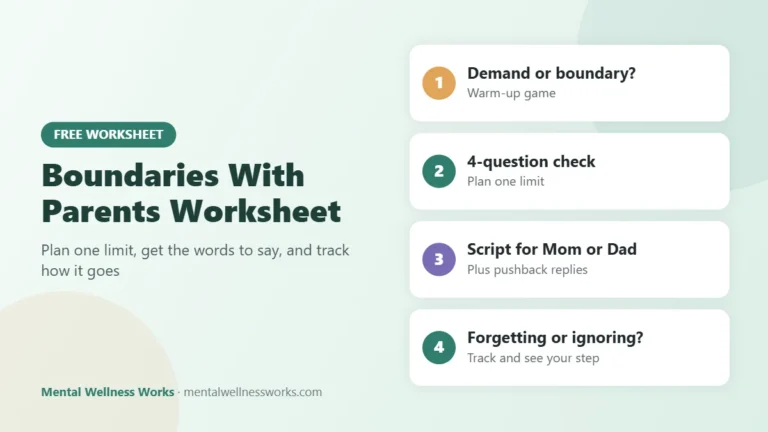
How the boundaries with parents worksheet works
- Warm-up: eight real-life lines. Tap “demand” or “boundary” and see why. Most people get a few wrong at first, because a firm-sounding demand feels like a boundary.
- Plan: choose who it is with, what keeps happening and your living situation, then answer the 4-question check. The boundaries with parents worksheet suggests realistic actions for that situation.
- Script: your plan becomes three short parts: appreciation, the limit and your action. Choose a warm or firm tone and whether you will say it in person or by text, then edit it so it sounds like you.
- Track: each time the boundary is tested, log what your parent did, whether you followed through and how calm you felt. Your boundaries with parents worksheet dashboard does the rest.
Why the warm-up matters: demands versus boundaries
The most common mistake is writing a rule for someone else. “Stop calling me every day” is a demand: your parent may or may not follow it, and you have no way to enforce it. “I can talk on Sunday afternoons; on other days I’ll text you back when I’m free” is a boundary, because it describes what you will do. It works even if your parent never changes.
Psychologist Dr. Karin Ryan makes the same point: a boundary is about your own behavior, not about controlling someone else. That is why every script the boundaries with parents worksheet writes ends with an action you control, such as changing the subject, ending a call or asking to reschedule.
The 4-question check
Before you speak, the boundaries with parents worksheet asks four questions. Writing the answers down makes the boundary specific enough to keep.
- What exactly is the behavior? “Unannounced visits”, not “disrespect”.
- What do you want instead? For example, a text before visiting.
- What will you do if it happens again? Pick an action you can carry out calmly.
- Can you realistically do that every time? If the answer is no or not sure, the boundaries with parents worksheet suggests shrinking the boundary until it is something you can keep.
Social worker Karen Salerno advises being specific and using clear “I” statements rather than hints (Cleveland Clinic). That is the idea behind the boundaries with parents worksheet: a small boundary you keep every time does more than a big one you drop after a week.
An example: daily calls from Mom
Aisha’s mother calls three or four times a day and gets upset when Aisha misses one. When Aisha first opens the boundaries with parents worksheet, she scores 5 out of 8 in the warm-up; she had been treating “You need to stop calling so much” as a boundary. Her plan: one proper catch-up on Sunday, texts on other days. Her script reads: “I love you, and I want our time together to feel good. I can talk properly on Sunday afternoons. On other days I’ll text you back when I’m free.”
Over the next two weeks she logs six moments. Her mother forgets twice, pushes back once with guilt (“I just worry about you”) and respects it three times. The dashboard shows step 2, restate, and the pushback tab gives her a reply: “I love you, and this isn’t about loving you less. My answer is still the same.” Her follow-through is 80%, and her calm score rises from 4 to 7.
If you live with or depend on your parents
Boundaries are harder when you share a home, rely on your parents for money or need their help with childcare. You may not be able to leave a situation or reduce contact whenever you want. The boundaries with parents worksheet adjusts its advice when you choose one of these situations: it suggests starting with privacy, personal decisions or how you are spoken to, and framing childcare limits around routines rather than criticism.
If raising a boundary could put your housing, finances or safety at risk, get support and plan your next steps before you raise it.
Forgetting or ignoring? How the dashboard decides
A parent who has done something for decades will often forget at first. Repeatedly dismissing a clearly stated boundary is different. The dashboard in the boundaries with parents worksheet looks at your recent entries for the same boundary and places you on a four-step ladder:
- Remind: a brief, friendly reminder when it looks like forgetting.
- Restate: say the limit again in one sentence, without a new debate.
- Follow through: when it keeps being tested, calmly do the action you named.
- Adjust: when it is ignored again and again, decide what contact feels manageable and safe, ideally with a therapist’s support.
The boundaries with parents worksheet also shows how often your parent respected the boundary, your own follow-through rate and how calm you felt. If your follow-through drops below half, it suggests a smaller action, because a limit without follow-through quietly turns back into a request.
Who this boundaries with parents worksheet is for
The boundaries with parents worksheet is for adults who keep putting off a conversation with a parent, who have tried before and been talked out of it, or who want to stay close to their parents without losing themselves in the relationship. It works for one parent or both, and for common situations such as visits, calls, advice, money, holidays, parenting criticism and privacy.
It is not therapy, and it is not designed for teenagers living at home or for relationships where a parent is violent or controlling through fear.
When a boundary is not enough
A boundary assumes it is reasonably safe to say your limit and follow through. If a parent has hit you, threatens you or uses intimidation to control your decisions, the boundaries with parents worksheet will not write a confrontation script; it points you to support instead. In immediate danger in the US, call 911. The National Domestic Violence Hotline is 1-800-799-7233. Outside the US, you can find a free helpline in your country through Find A Helpline. A licensed mental health professional can also help you plan.
Frequently asked questions
What is a good example of a boundary with parents?
“I’d love to see you. Please text before you come so we can pick a time that works. If you drop by unannounced, I’ll ask to reschedule.” It states the limit and what you will do.
What if my parents get angry when I set a boundary?
Anger is a common first reaction to a changed pattern and does not prove the boundary is unfair. Acknowledge the feeling and keep the limit: “I can see this is hard to hear. I’m still going to end the call.”
Should I set a boundary by text?
Yes, if live conversations quickly turn tense. Choose “text or letter” in the script step and the boundaries with parents worksheet writes a shorter version that starts with “Hi Mom” or “Hi Dad”.
Is my information private?
Yes. Your plan, script and log are saved only in your browser on your device. You can download the log or delete everything at any time.
Sources
- Salerno K. How to set healthy boundaries. Cleveland Clinic Health Essentials; 2026.
- Ryan K. Boundaries: what they are and how to set them. Sagent Behavioral Health (formerly Nystrom & Associates).
- National Domestic Violence Hotline. thehotline.org.
- Find A Helpline. findahelpline.com.