
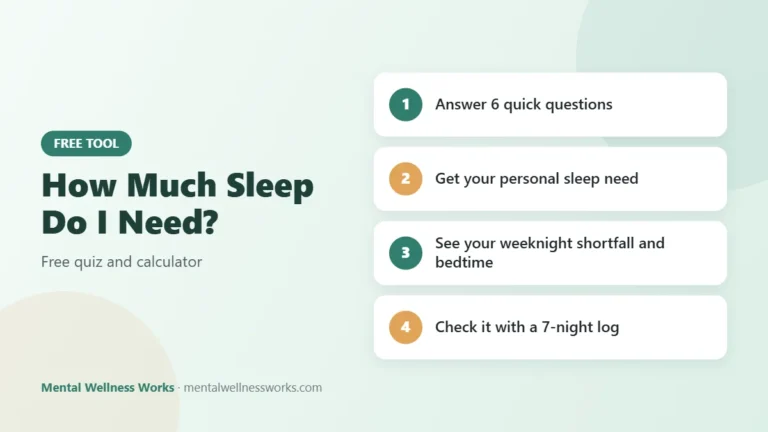
How much sleep do I need? Most adults need at least 7 hours of sleep a night, but your own number can sit anywhere in the recommended range. This free quiz and calculator estimates your personal sleep need from your age and how you actually sleep, shows how far your weeknights fall short, and gives you a bedtime that fits your wake-up time. A 7-night log then lets you check whether the estimate fits how you feel.
How Much Sleep Do I Need?
Answer six quick questions to estimate your personal sleep need, see how far your weeknights fall short, and get a bedtime that fits your wake-up time. Then check the estimate with a 7-night log.
Your estimated sleep need
hours a night
Weeknight gap
per night
Weekly shortfall
over 5 work nights
Bedtime
What your answers suggest
This is an estimate based on your answers and published age ranges, not a medical assessment.
Each morning, log how long you slept and how alert you felt by mid-morning. After five or more nights, the dashboard compares your alertness on nights at or above your estimated need with shorter nights.
Nights logged
aim for 7
Average sleep
Alertness
average out of 5
Your nights against your estimated need
For general education, not medical advice. Your answers and log stay in this browser on your device. If you are very sleepy most days despite enough sleep, snore loudly or stop breathing in sleep, talk to a doctor.
How much sleep do I need by age?
| Age group | Age | Recommended sleep per night |
|---|---|---|
| Teens | 13–17 years | 8–10 hours |
| Adults | 18–60 years | 7 or more hours |
| Adults | 61–64 years | 7–9 hours |
| Older adults | 65 years and older | 7–8 hours |
These are ranges, not exact targets, so the question “how much sleep do I need?” has no single answer for everyone. Some people feel and function best at the low end, others at the high end. Regularly sleeping less than the bottom of your range is linked with poorer mood, focus and health over time.
How this calculator answers “how much sleep do I need?”
The best everyday clue to your sleep need is how long you sleep when nothing wakes you: no alarm, no early meetings, and a few days into a holiday, once any catch-up sleep is out of the way. The calculator starts with that number and then:
- Takes off a little if you sleep much longer on free days than on workdays, because part of that extra sleep is likely catch-up for sleep debt.
- Adds a little if you feel sleepy most days even though you sleep close to your free-day amount.
- Keeps the result inside the recommended range for your age.
Your bedtime is your wake-up time minus your estimated need, minus about 15 minutes to fall asleep. The 7-night log compares your mid-morning alertness on nights at or above your need with shorter nights, which is a simple way to test the estimate on yourself.
Signs you may not be getting enough sleep
When you ask yourself “how much sleep do I need?”, your daytime energy is one of the best clues. These are common signs that you may be getting less than your body needs:
- You rely on an alarm and still struggle to get up most mornings.
- You sleep much longer on weekends or days off.
- You feel sleepy in meetings, while reading or as a passenger.
- You need caffeine to get through the morning or afternoon.
- Small worries feel bigger and your mind races more at night.
Short sleep and overthinking often feed each other. If a busy mind is what keeps you up, read why overthinking gets louder at night and try the night thoughts sleep log.
When to talk to a doctor
Talk to a doctor if you feel very sleepy most days even after enough sleep, if someone notices you snore loudly or stop breathing during sleep, or if trouble falling or staying asleep goes on for weeks. Conditions such as sleep apnea and insomnia are common and treatable. For long-running insomnia, cognitive behavioral therapy for insomnia (CBT-I) is a commonly recommended first treatment.
How to use your sleep need result
Your answer to “how much sleep do I need?” is a starting point for an experiment, not a fixed rule. Set your bedtime from the calculator for one to two weeks, keep your wake-up time steady, including at weekends, and log each morning in the 7-night check. If you feel alert by mid-morning on most days, your estimate is about right. If you still feel foggy, try 15 to 30 minutes more, and if that does not help, talk to a doctor.
Frequently asked questions
Is 6 hours of sleep enough?
For most adults, no. The recommendation for adults is 7 or more hours a night. A small number of people seem to need less, but feeling fine on 6 hours is often a sign of getting used to sleep loss rather than needing less.
Can I catch up on sleep at the weekend?
Extra sleep on days off can ease some tiredness, but it does not fully undo a week of short nights, and sleeping in late can make it harder to fall asleep on Sunday night. A steadier bedtime through the week usually works better. Our sleep debt calculator shows a gentle catch-up plan.
Is more sleep always better?
Not necessarily. Regularly needing much more than 9 hours as an adult, or feeling unrefreshed after long sleep, can be a sign of a health issue worth checking with a doctor.
How accurate is a sleep calculator?
Any calculator gives an estimate. Yours is based on your own answers, so it is more personal than a single number, but the 7-night check is the best way to see whether it fits you.
How much sleep do I need as an older adult?
Adults aged 65 and older are recommended 7 to 8 hours a night. Sleep often becomes lighter with age, but the need for sleep does not disappear.
Sources
- Centers for Disease Control and Prevention. About Sleep: How much sleep do I need?
- Watson NF, et al. Recommended amount of sleep for a healthy adult: a joint consensus statement of the American Academy of Sleep Medicine and Sleep Research Society. Sleep. 2015;38(6):843–844.
- Hirshkowitz M, et al. National Sleep Foundation’s sleep time duration recommendations: methodology and results summary. Sleep Health. 2015;1(1):40–43.
- Paruthi S, et al. Recommended amount of sleep for pediatric populations: a consensus statement of the American Academy of Sleep Medicine. J Clin Sleep Med. 2016;12(6):785–786.