
Worry time is a simple technique: instead of fighting a worry whenever it appears, you postpone it to a short, fixed time each day. This free tool combines worry time with a 3-question rumination check. Run any loop through the check, decide whether to act, postpone or let it pass, and your dashboard shows how much time loops take and how often you break them.
What is worry time, and does it work?
Worry time, also called worry postponement or stimulus control for worry, was first described by Thomas Borkovec and colleagues in 1983. People set aside a regular 30-minute worry period and postponed worries that came up at other times. In that early study, worry decreased compared with a control group (Borkovec et al., 1983). A later preliminary trial found that the approach reduced worry, anxiety and insomnia symptoms (McGowan & Behar, 2013).
Many therapists now suggest a shorter period, often 15 to 30 minutes, at the same time each day and not too close to bedtime. Postponing a worry is easier than suppressing it, because you are not telling yourself “never”, only “not now”.
Rumination or problem-solving? The 3-question check
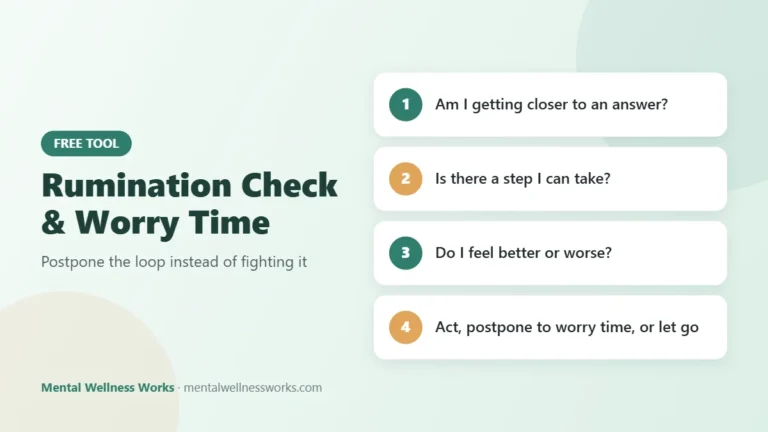
Not all repetitive thinking is harmful. Research separates constructive thinking, which is concrete and moves toward a decision, from unconstructive rumination, which is abstract and keeps circling “why” (Watkins, 2008). Rumination is linked with low mood and anxiety over time (Nolen-Hoeksema et al., 2008). The tool asks three quick questions:
- Am I getting closer to an answer or a decision?
- Is there a step I can actually take?
- Do I feel better or worse than when I started?
If you are not getting closer and you feel the same or worse, it is probably rumination. Thinking harder will not solve it, but a next step or a postponement can.
An example of worry time
During the morning, Tom notices he is replaying a comment from his manager. He runs it through the check: not closer to an answer, no step he can take before tomorrow, and he feels worse. That makes it rumination, so he chooses “Postponed it to worry time” and estimates it has already taken 20 minutes.
At 5:30 pm, his 15-minute worry time, he looks at his list. Two of the morning’s worries no longer feel important. For the manager comment, he writes one step: ask for five minutes in tomorrow’s one-to-one. After a week, his dashboard shows that about two thirds of his loops were rumination, that he spent roughly three hours a week in them, and that he broke more of them as the week went on.
Who this tool is for
It is for people who find themselves going over the same problem again and again, especially if the thinking happens at work, during conversations or at bedtime. It is also helpful for anyone learning worry postponement as part of CBT.
How to use the worry time tracker
- Name the loop in a few words.
- Answer the three questions.
- Estimate how many minutes it has been running.
- Decide: take a next step, postpone it to worry time, let it pass, or note that you kept going.
- At your worry time, look at the repeating words on your dashboard and deal with what is still important.
What your dashboard shows
- Loops logged in the last seven days.
- Rumination share, the loops that did not move you toward an answer.
- Time in loops this week, and a daily minutes chart.
- Loops broken, the share you stepped on, postponed or let go.
- What you did with your loops and the words that keep coming back.
Our full guide on how to stop ruminating explains why the mind keeps returning to the same thought and what to do when there is no answer to find.
Tips for a worry time that works
- Keep it the same time each day, ideally late afternoon or early evening.
- Keep it short: 15 minutes is enough for most people.
- Write worries down during the day so you can let them go until then.
- At worry time, ask of each item: is there one thing I can do today?
- End on time, even if some worries are still there.
Frequently asked questions
How long should worry time be?
Studies used about 30 minutes; many people do well with 15. What matters most is keeping it regular and ending on time.
What if a worry feels urgent?
Ask whether there is a step you can take right now. If there is, take it. If not, write it down for worry time.
Can worry time help with sleep?
Moving worry earlier in the day can help some people fall asleep more easily, and one preliminary study found improvements in insomnia symptoms.
Is this tool private?
Yes. Your entries are saved only in your browser.
Sources
- Borkovec TD, Wilkinson L, Folensbee R, Lerman C. Stimulus control applications to the treatment of worry. Behavior Research and Therapy. 1983;21(3):247–251.
- McGowan SK, Behar E. A preliminary investigation of stimulus control training for worry: effects on anxiety and insomnia. Behavior Modification. 2013;37(1):90–112.
- Watkins ER. Constructive and unconstructive repetitive thought. Psychological Bulletin. 2008;134(2):163–206.
- Nolen-Hoeksema S, Wisco BE, Lyubomirsky S. Rethinking rumination. Perspectives on Psychological Science. 2008;3(5):400–424.