
Reassurance seeking means asking someone, checking or searching again and again to feel sure that everything is okay. It brings quick relief, but the relief fades and the doubt often comes back louder. This free tool helps you pause before acting on the urge: rate it, wait with a 20-minute timer, rate it again and see on your dashboard how often it settles without reassurance.
Why reassurance seeking keeps the doubt going
Researchers who study anxiety and obsessive-compulsive problems describe reassurance seeking as a common behavior that can maintain worry rather than resolve it (Kobori & Salkovskis, 2013). The pattern is simple: doubt rises, you ask or check, you feel better for a while, and your brain learns that the doubt needed handling. Next time, it asks again sooner.
This does not mean you should never talk to your partner about your feelings. Honest conversations are healthy. The difference is between one open conversation and the same question asked many times in different words, or checking that happens over and over.
How to use the pause timer
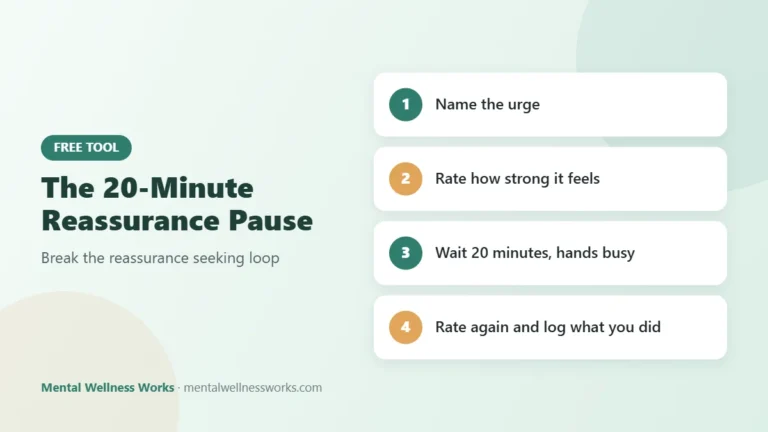
- Choose the urge: asking if you are okay, checking their phone or location, rereading old messages, searching online, asking a friend, or comparing with past partners.
- Rate how strong it feels, from mild to overwhelming.
- Start the 20-minute pause. Name the doubt (“there is the what-if again”), do something with your hands, or write the fear in one line.
- Rate the urge again when the timer ends.
- Log what you did: waited and the urge passed, waited then talked calmly, or acted right away.
If 20 minutes feels impossible at first, start with five. The aim is to build the gap between urge and action, not to be perfect.
An example of the pause in action
Leo’s partner has not replied for three hours. The urge to send “Are we okay?” is at 8 out of 10. Instead of texting, he chooses “Ask if we are okay” in the tool, starts the 20-minute timer, names the thought (“there is the what-if again”) and goes to wash the dishes.
When the timer ends, the urge is at 4. He logs “Waited, and the urge passed” and adds a note: “She was in a meeting.” Over two weeks his dashboard shows that he waited before acting on 65% of urges and that the urge dropped by about three points on average. Seeing that pattern in his own numbers makes the next pause a little easier, because he has proof that the anxiety settles without an answer.
Who this tool is for
It is for people who often seek reassurance in a relationship, from a partner, friends or online searches, and want to break the cycle. It can also help with reassurance seeking about health, work or past conversations. If the urges are part of OCD, this tool can support, but not replace, treatment with a qualified therapist.
Tips for the waiting time
- Keep your phone in another room for the 20 minutes.
- Do something with your hands: tidy up, cook or go for a short walk.
- Write the fear once in the note field, then stop adding to it.
- Remind yourself that uncertainty is uncomfortable, not dangerous.
What your dashboard shows
- Urges logged and your streak of practice days.
- Waited, the share of urges where you paused before acting.
- Average drop in urge strength after pausing.
- Before-and-after chart for your last 14 urges.
- Your most common urges and repeating words from your notes.
Many people find their urge drops noticeably during the pause. Seeing that in your own data is often more convincing than any advice.
Is it relationship anxiety or a real warning sign?
Anxious doubt tends to be vague, repetitive and focused on what might happen. Real warning signs are usually specific and observable: broken agreements, disrespect, control or harm. Our guide to overthinking in a relationship walks through how to tell the difference. If you feel unsafe in a relationship, reach out for support right away.
When to get more support
If reassurance seeking takes up a lot of your day, strains your relationship or comes with intrusive thoughts that feel impossible to ignore, a therapist experienced in anxiety or OCD can help. Approaches such as cognitive behavioral therapy work on this exact pattern step by step.
Frequently asked questions
Is it wrong to ask my partner for reassurance?
No. Asking now and then is normal. It becomes a problem when the same question is asked repeatedly and the relief never lasts.
Why 20 minutes?
It is long enough for most urges to peak and begin to ease, and short enough to feel doable. You can start shorter and build up.
What should I do while I wait?
Name the doubt, do something physical, call a friend about something else, or write the fear in one line in the note field.
Is this tool private?
Yes. Your entries stay in your browser on your device and are never sent to us.
Sources
- Kobori O, Salkovskis PM. Patterns of reassurance seeking and reassurance-related behaviors in OCD and anxiety disorders. Behavioural and Cognitive Psychotherapy. 2013;41(1):1–23.