
When your mind is running ahead of you, three minutes can be enough to step back. This free guided timer walks you through the 3 minute breathing space, a short practice from mindfulness-based cognitive therapy (MBCT), one step at a time, with an optional chime between steps.
3-Minute Breathing Space Timer
A guided version of the Three-Minute Breathing Space from mindfulness-based cognitive therapy (MBCT). Three steps, about a minute each. Eyes open or closed, sitting or standing.
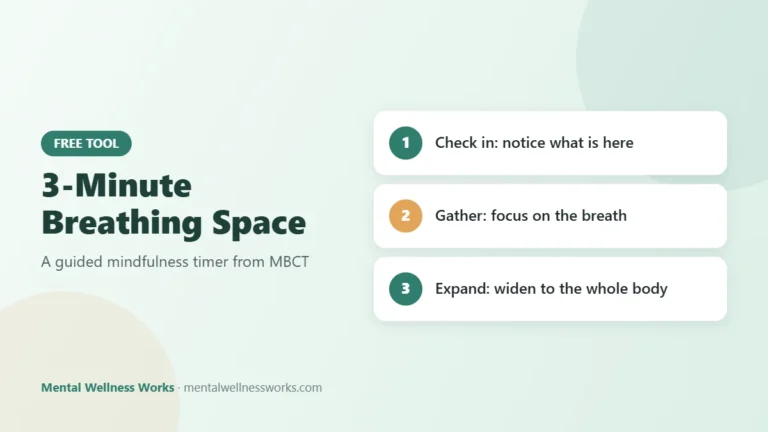
- Check inWhat is here right now?
- GatherBreath in the belly
- ExpandWhole body, whole room
Press start when you’re ready. You don’t need to feel calm for this to count.
Before you go back
Carry that wider awareness into the next few minutes. Then ask one question: “What do I want to do next?” The answer might be nothing. Either way, it’s a choice, not a reaction.
If loops keep returning, try our 2-minute overthinking quiz or the guide on how to stop ruminating.
If focusing on your breath or body raises panic or distress, stop, open your eyes and feel your feet on the floor. This tool is for general wellbeing, not medical treatment. In crisis, call or text 988 (US) or visit findahelpline.com.
What is the 3 minute breathing space?
The 3 Minute Breathing Space was developed by Zindel Segal, Mark Williams and John Teasdale as part of MBCT, a program first built to help prevent relapse in recurrent depression. It is designed for the middle of a hard moment, or any time you notice you are running on autopilot. It has three steps, often described as an hourglass: wide, narrow, then wide again.
- Check in: notice the thoughts, feelings and body sensations that are here right now, without trying to fix them.
- Gather: narrow your attention to the breath in your belly, and gently come back each time your mind wanders.
- Expand: widen your attention to your whole body and the space around you, holding whatever is there in that wider awareness.
Why it helps overthinkers
The 3 minute breathing space does not try to stop thoughts. It trains you to notice that you have been carried off by one and to step back from it, a skill researchers call decentering. MBCT, the program it comes from, has good evidence: a large analysis of randomised trials found it reduced the risk of depressive relapse compared with usual care (Kuyken et al., 2016). The breathing space on its own is a short practice, so think of it as a way to interrupt a loop, not a treatment.
How to use 3 Minute breathing space timer
Press start and follow the prompts. A soft chime marks each new step, and you can turn it off. Choose a shorter or longer version if three minutes does not fit. Practicing on calm days, not only in bad moments, makes the skill easier to reach when you need it. The aim is not a quiet mind. It is noticing that you have been carried off by a thought, and stepping back.
An example
Before a difficult call, Ali notices his thoughts racing through everything that could go wrong. He opens the timer. In the first minute he names what is there: “tight chest, what-if thoughts, irritation”. In the second, he follows the breath in his belly and comes back four or five times when his mind drifts. In the third, he widens his attention to his feet, his hands on the desk and the room. The worries are still there, but they feel more like thoughts and less like facts, and he starts the call a little steadier.
Good moments to take a breathing space
- When you notice you are replaying a conversation.
- Before a meeting, call or difficult message.
- When you feel the urge to check your phone or seek reassurance.
- At set times each day, such as after lunch, to build the habit.
- Before bed, if your mind tends to speed up at night.
To track how quickly you notice thoughts during the day, pair it with the noting meditation practice log. For a body-first reset when thoughts race, try the 5 4 3 2 1 grounding technique.
Tips for a better breathing space
- Sit or stand upright, but stay comfortable. A dignified posture helps you stay awake and present.
- Do not try to breathe in a special way. Just notice the breath as it is.
- Use a word for each step if it helps: “notice”, “breathe”, “widen”.
- When the timer ends, take one small, deliberate action, such as replying to one message or starting one task.
When mindfulness is not the right fit
Mindfulness does not suit everyone at every moment. If focusing on your breath or body raises panic or distress, stop and try something active instead, such as walking or grounding through your senses, and talk with a licensed professional if it keeps happening. Mindfulness is not a replacement for treatment of anxiety, depression or trauma.
Frequently asked questions
Do I need to close my eyes?
No. You can keep your eyes open with a soft gaze, which many people find easier at work or in public.
How often should I practice?
Once or twice a day on calm days, plus whenever you notice a loop starting. Short, regular practice builds the skill.
What if my mind keeps wandering?
That is normal and part of the practice. Each time you notice and come back, you are training the skill.
Is the 3 minute breathing space the same as meditation?
It is a short, structured mindfulness practice. It can be used on its own or alongside longer meditation.
Sources
- Segal ZV, Williams JMG, Teasdale JD. Mindfulness-Based Cognitive Therapy for Depression. 2nd ed. Guilford Press; 2013.
- Kuyken W, et al. Efficacy of mindfulness-based cognitive therapy in prevention of depressive relapse: an individual patient data meta-analysis from randomized trials. JAMA Psychiatry. 2016;73(6):565–574.