
Noting meditation means giving a thought a quick, one-word label, such as “planning” or “worrying”, when you notice it, and then gently returning to the present. This free practice log helps you build that skill during the day. Each time you catch a thought, log its type, how quickly you noticed it and what brought you back, and your dashboard shows whether you are noticing sooner over time.
Mindfulness changes your response, not your thoughts
A common misunderstanding is that mindfulness should make thoughts stop. It does not. What it trains is the ability to notice a thought as a thought and step back from it, a process researchers call decentering (Bernstein et al., 2015). For overthinkers, that matters: the sooner you notice you are in a loop, the less time it takes from you.
Noting is a practical way to build that skill. Labeling an experience in words has been linked with reduced emotional intensity in brain imaging research (Lieberman et al., 2007).
How to practice noting meditation
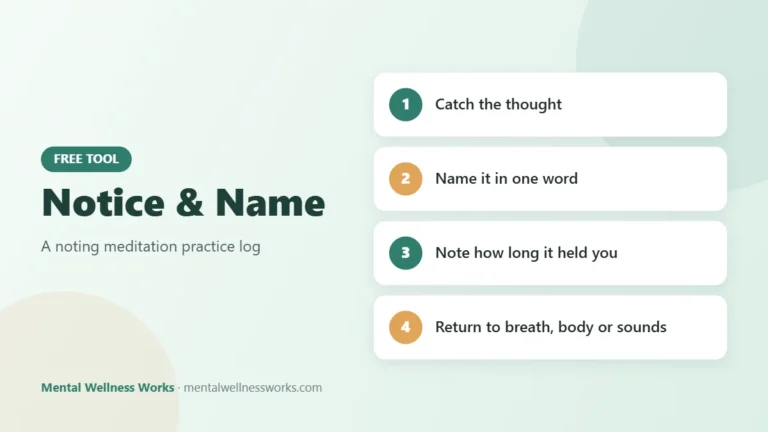
- Notice that your attention has drifted into a thought.
- Name it with one soft word: worrying, planning, judging, remembering, comparing.
- Return to an anchor: your breath, your feet on the floor, or the sounds around you.
- Log it afterwards in a few seconds: the type of thought, how quickly you noticed, roughly how long it held you, and what brought you back.
You can do this during a formal sitting practice or at ordinary moments of the day, such as waiting in a queue or opening your phone.
An example of noting during the day
Elena sets a reminder to notice her thoughts each time she opens her phone. At 10 am she realizes she has spent several minutes rehearsing an argument with a colleague. She names it “imagining arguments”, takes one slow breath, notices her feet on the floor and logs it: pulled in, then noticed, about 6 minutes, brought back by body or feet.
By the end of the first week, her dashboard shows that planning and imagining arguments are her most common thoughts, that she noticed about a third of them straight away, and that thoughts held her for about seven minutes on average. In the third week she is catching half of them straight away and the average time has dropped to four minutes. She still has the same kinds of thoughts; she simply spends less time lost in them.
Who this practice log is for
It is for people who are new to mindfulness, people who meditate but want to bring the skill into everyday life, and overthinkers who want a concrete way to see whether their practice is making a difference.
Common noting labels
- Worrying for future what-ifs.
- Planning for lists and schedules.
- Judging for criticism of yourself or others.
- Remembering for replaying the past.
- Comparing for measuring yourself against others.
- Imagining arguments for rehearsed conversations.
What your practice dashboard shows
- Noticed quickly, the share of thoughts you caught straight away.
- Time held, the average minutes a thought held you this week.
- Most common thought type and your streak.
- A daily chart of thoughts noticed straight away compared with those that pulled you in first.
- What brings you back most, so you know which anchor to use.
Tips to make noting easier
- Keep labels simple and kind. “Planning” is enough; there is no need to judge the thought.
- Practice little and often. A few noted thoughts a day are more useful than one long session a week.
- Use set moments as reminders, such as each time you open your phone or wait for the kettle.
- If labeling makes you more anxious, return to the breath or body instead.
Our guide Mindfulness won’t stop overthinking: it changes your response explains what research shows and when mindfulness may not be the right fit. For a short guided practice, try the 3-minute breathing space.
When mindfulness is not enough
Mindfulness can be uncomfortable for some people, especially those with a history of trauma, and it is not a replacement for treatment of anxiety or depression. If practice brings up distressing feelings, pause and talk with a qualified professional.
Frequently asked questions
What is noting meditation?
It is a mindfulness practice in which you silently label what you notice, such as a thought, sound or feeling, with a simple word, then return to your anchor.
How often should I practice noting?
A few minutes a day, or several brief moments of noting during the day, is a good start.
Will noting stop my overthinking?
It will not stop thoughts, but it can help you notice loops sooner and get caught in them for less time.
Is my practice log private?
Yes. Your entries stay in your browser on your device.
Sources
- Bernstein A, et al. Decentering and related constructs: a critical review and metacognitive processes model. Perspectives on Psychological Science. 2015;10(5):599–617.
- Lieberman MD, et al. Putting feelings into words: affect labeling disrupts amygdala activity in response to affective stimuli. Psychological Science. 2007;18(5):421–428.