
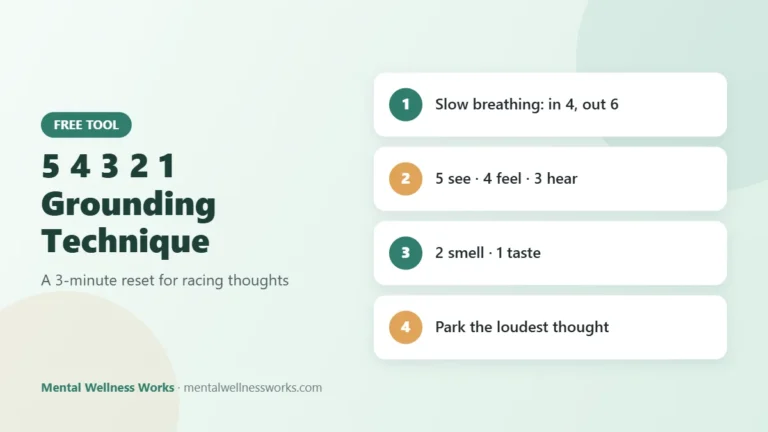
The 5 4 3 2 1 grounding technique brings your attention back to the room by naming five things you can see, four you can feel, three you can hear, two you can smell and one you can taste. This free guided tool starts with slow breathing, walks you through each step with a timer, and lets you rate how fast your thoughts are before and after, so your dashboard can show what works best for you.
Why slow the body before the mind
Racing thoughts often come with a racing body: a faster heart rate, shallow breathing and tense muscles. Slow breathing is one of the simplest ways to turn that down. A systematic review found slow breathing linked with increased relaxation and reduced arousal and anxiety (Zaccaro et al., 2018), and a 2023 study found that a few minutes a day of breathing with long exhales improved mood and reduced physiological arousal (Balban et al., 2023).
That is why the guided reset starts with breathing in for 4 and out for 6. Once the body settles a little, grounding your attention in your senses is easier.
How the 5 4 3 2 1 grounding technique works
- 5 things you can see. Small details count: a mark on the wall, the color of a mug.
- 4 things you can feel. Your feet on the floor, the chair, your clothes, the air on your skin.
- 3 things you can hear. Near sounds and far sounds.
- 2 things you can smell. Or two smells you like, if nothing stands out.
- 1 thing you can taste. Or take a sip of water and notice it.
Grounding is widely taught by therapists as a way to interrupt a spiral. Direct research on this exact exercise is limited, so think of it as a practical tool for the moment, not a treatment. The final step in the tool asks you to write down the loudest thought, which parks it for later. In one sleep-lab study, writing a short to-do list at bedtime was linked with falling asleep faster (Scullin et al., 2018).
An example reset
It is 11 pm and Sara’s thoughts are jumping between an unpaid bill, a message she has not answered and tomorrow’s presentation. She rates their speed at 8 and picks “Bedtime”.
She follows the guided steps: 40 seconds of slow breathing, then five things she can see in the dim room, the weight of the blanket, the hum of the fridge, the smell of her pillowcase and a sip of water. At the last step, she parks the loudest thought: “Pay the bill at 9 am.” She rates her thoughts at 4 and ticks “Slow breathing” and “Writing it down” as what helped.
After two weeks, her dashboard shows that her thoughts race most at bedtime and after scrolling, and that slow breathing is her most helpful step. She now does the reset before putting her phone away, not after an hour of lying awake.
Who this tool is for
It is for anyone whose thoughts speed up under stress, before events, at bedtime or after too much screen time, and who wants a short, structured way to slow down.
How to use the guided timer
- Rate how fast your thoughts are and choose when it is happening.
- Press start and follow each step; the timer moves on by itself.
- Park the loudest thought in one line.
- Rate your thoughts again and tick what helped most.
The whole reset takes about three minutes. Use it early, before the racing builds, for the best effect.
What your dashboard shows
- Resets completed.
- Average slowdown in thought speed after the reset.
- Most helpful step, such as breathing or touch.
- Usual time your thoughts race, such as bedtime or after scrolling.
- Before-and-after chart and the thoughts you parked most often.
For more ways to calm a busy mind, read how to stop racing thoughts, including the Sort-and-Park method and the habits that make racing thoughts louder.
When racing thoughts need a doctor
Racing thoughts are common with stress and anxiety. Talk to a doctor if they come with very little need for sleep, unusual energy, risky decisions, or if they are constant and affect your daily life. These can be signs of conditions that need proper assessment.
Frequently asked questions
What is the 5 4 3 2 1 grounding technique?
It is a sensory exercise where you name five things you see, four you feel, three you hear, two you smell and one you taste, to bring your attention back to the present.
How long does grounding take to work?
Many people notice a small shift within a few minutes. Practising when you are only a little stressed makes it easier to use when it really matters.
Can grounding help with anxiety at night?
It can help you step out of a spiral at bedtime. Pair it with a notebook to park thoughts and a steady sleep routine.
Is my data private?
Yes. Your ratings and parked thoughts stay in your browser on your device.
Sources
- Zaccaro A, et al. How breath-control can change your life: a systematic review on psycho-physiological correlates of slow breathing. Frontiers in Human Neuroscience. 2018;12:353.
- Balban MY, et al. Brief structured respiration practices enhance mood and reduce physiological arousal. Cell Reports Medicine. 2023;4(1):100895.
- Scullin MK, et al. The effects of bedtime writing on difficulty falling asleep: a polysomnographic study comparing to-do lists and completed activity lists. Journal of Experimental Psychology: General. 2018;147(1):139–146.