
This free no contact tracker is for the days when someone keeps coming back to mind and the urge to check their profile or send one more message feels strong. Log each thought in under a minute, note what set it off and whether you acted on the urge, and your dashboard shows your triggers, the urges you resisted and how the thoughts change over time.
Why it is so hard to stop thinking about someone
Losing someone, or wanting someone you cannot have, can hurt in a physical way. Brain imaging research has found that intense social rejection activates some of the same regions involved in physical pain (Kross et al., 2011). Another study of people recently rejected in love found activity in reward and craving systems, which helps explain why checking on them can feel almost compulsive (Fisher et al., 2010).
Trying to force the thoughts away often backfires. In classic experiments, people told not to think about something tended to think about it more afterwards (Wegner et al., 1987). A tracker takes a different approach: instead of fighting each thought, you notice it, record it and let it pass, which builds evidence that the urge fades on its own.
How to use the no contact tracker
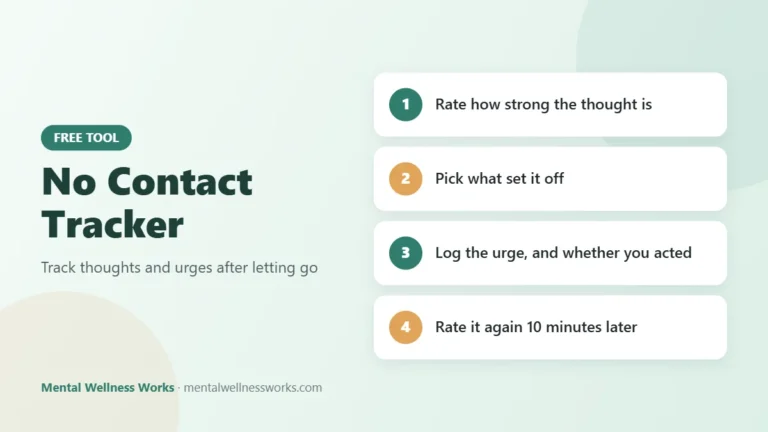
- Rate the thought from passing to consuming when it shows up.
- Pick the trigger: a memory, a song or place, social media, night time, a message, seeing them, or nothing obvious.
- Log the urge: no urge, an urge you let pass, checking their profile, or texting or calling.
- Write what you did instead, or could do next time, such as texting a friend or going for a short walk.
- Rate it again about 10 minutes later.
An example week
Aisha ended a relationship three weeks ago. On Monday she logs four thoughts, three of them at night, and checks his profile twice. By Thursday her dashboard shows that night time and social media are her top triggers, and that the thoughts usually drop from 8 to about 5 within ten minutes.
She archives his profile, makes a short playlist for bedtime and decides to wait 20 minutes before acting on any urge. The following week she logs about the same number of thoughts, but her “urges resisted” figure rises from 30% to 70%, and the days since last contact keep climbing. Nothing about the feelings disappeared overnight; what changed was the habit of feeding them.
Who this tracker is for
It is for anyone who cannot stop thinking about someone, whether after a breakup, an unrequited crush, a friendship that ended or someone who stopped replying. You do not need to be following strict no contact to use it; you can simply track how often you check or reach out and decide what you want to change.
What your dashboard shows
- Thoughts logged in the last seven days.
- Urges resisted, the share of urges you let pass without checking or contacting.
- Days since last contact, if you are keeping no contact.
- Top trigger and a chart of what sets the thoughts off.
- Thoughts per day over 14 days, with the days you acted on an urge highlighted.
If you acted on most urges in the last week, the dashboard says so gently and suggests a smaller first step, such as muting or archiving their profile and waiting 20 minutes before acting.
Simple ways to make the urges weaker
- Mute, archive or unfollow so their updates do not appear by surprise.
- Plan one specific action for your top trigger, such as a playlist for night time.
- Wait 20 minutes before checking or texting. Urges usually peak and then ease.
- Tell one trusted person what you are working on.
- Notice progress in weeks, not days. The trend matters more than any single bad day.
Our full guide explains why letting go is hard and what actually helps, including when you see the person every day.
When to get more support
If thoughts about someone take over most of your day for weeks, affect your sleep or work, or come with feelings of hopelessness, talk to a doctor or licensed therapist. If you ever feel unsafe, call or text 988 in the US or find a helpline in your country at findahelpline.com.
Frequently asked questions
Does no contact really help you stop thinking about someone?
For many people it helps, because each check or message tends to restart the loop. It is not a rule for every situation, such as co-parenting, but reducing contact and checking usually makes thoughts less frequent over time.
How long does it take to stop thinking about someone?
There is no fixed timeline. Many people notice the thoughts become less frequent and less intense over weeks to months, especially when they stop checking and keep up their own routines.
Is it normal to keep checking their social media?
Yes, it is very common. Checking brings brief relief, which is exactly why it becomes a habit. Tracking it is the first step to changing it.
Is my data private?
Yes. Your entries are saved only in your browser on your device.
Sources
- Kross E, Berman MG, Mischel W, Smith EE, Wager TD. Social rejection shares somatosensory representations with physical pain. PNAS. 2011;108(15):6270–6275.
- Fisher HE, Brown LL, Aron A, Strong G, Mashek D. Reward, addiction, and emotion regulation systems associated with rejection in love. Journal of Neurophysiology. 2010;104(1):51–60.
- Wegner DM, Schneider DJ, Carter SR, White TL. Paradoxical effects of thought suppression. Journal of Personality and Social Psychology. 1987;53(1):5–13.